

Originally published at Medium on April 23, 2022
For years now, we’ve been hearing about a “loneliness epidemic” sweeping the United States. Two years of pandemic disruptions have only increased coverage of the topic in the popular press. Loneliness is not trivial – it can be a very difficult part of the human condition to experience. My goal here is not to dispute any rigorous evidence showing increasing self-reports of loneliness in the population, nor is it to lecture the lonely to “snap out of it.” What interests me are the counterproductive and at times flat-out wrong ways that we talk and think about loneliness and how those ways keep us stuck.
This starts with the apparently unending confusion around what loneliness is. Often, when an article states that loneliness is on the rise, the sentences that follow point out trends such as increasing rates of living alone, decreasing rates of marriage, and smaller family sizes. Discussions about loneliness that follow this common path miss a crucial distinction. Loneliness is a subjective state, which may not at all be correlated with objective measures like the amount of time in a week spent with others.
Nonetheless, one of the most common cures offered for loneliness involves increasing time spent with others. Despite the seeming “common sense” of this approach, I believe it is often a misguided effort to put a band-aid on a two-pronged reality that we often don’t care to acknowledge. First, that loneliness is inseparable from the human experience, and second, that modern life and social norms turn this inseparability against us in absurd and at times cruel fashions.
Through the ages, the philosophers, artists, and poets have spoken to the intrinsic nature of loneliness in life. We see in countless works how the angst and sorrow driven by a feeling of separateness can fuel creativity and profound insight about what it means to be human. We see how loneliness, when worked with and unabashedly experienced, can be a component of building a meaningful life.
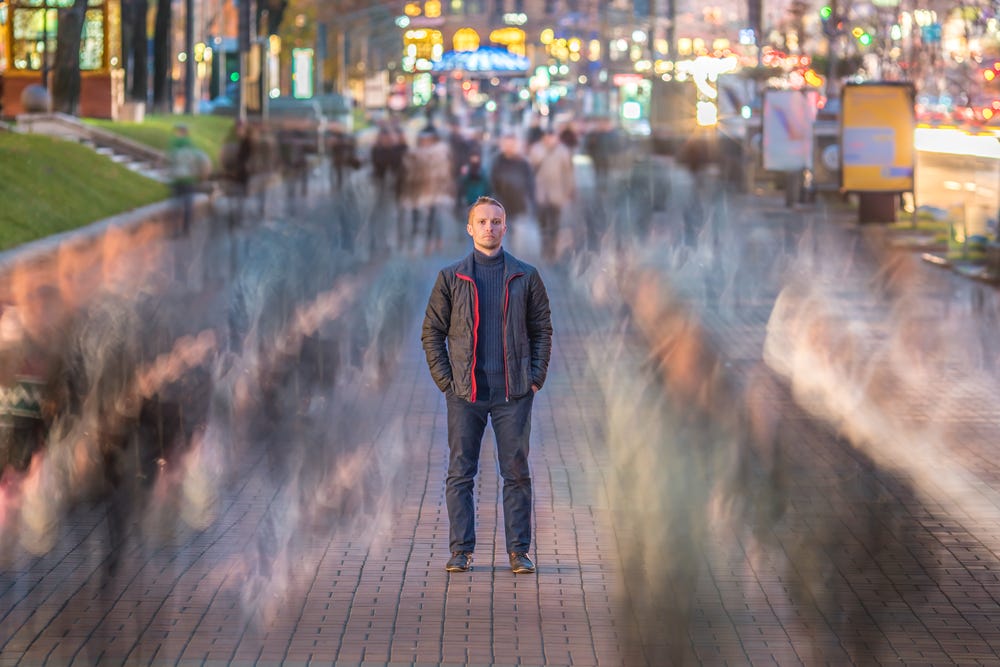
Modern Americans, by and large, are not encouraged to consult with the wisdom that has been accumulated over the centuries when faced with their own loneliness. Instead, we’re fed the thin gruel of “Try making new friends.” We’re not led to believe that the rawness of our loneliness can lead to our own beautiful works of creativity that can serve as a beacon for ourselves and others through the dark passages of our lives. Instead, we’re asked, “Have you tried online dating?”
The paltry nature of this common advice on loneliness reflects a much bigger reality for 21st century Americans: we are socialized to live paltry lives. This is reflected most in our national obsession with happiness. As a middle class, white American, I can tell you one thing with certainty: every ounce of my socialization in this culture led me to believe that the purpose of life is to be happy. In other words, you grow up, you run around doing shit that makes you happy, and you die. The end.
Everything I was told to do was for the purpose of increasing my likelihood of happiness at some future date. Whenever I was around others, I was to always be happy lest the reality of my humanity scare them off, thus rendering friend-making and lady-fucking impossible and putting life’s only meaningful pursuits out of reach.
If there really is an epidemic of loneliness in our society today, I propose that one of the primary drivers is this steamroller of American Happiness. When our lives are flattened to the point where everything rests on whether or not we’re experiencing one emotion, how could anything but loneliness follow? When, in addition, we are told that there are only one or two life paths that will access that one emotion, how could anything but desperation and fear follow?
In this context, telling people to spend more time with others to absolve their loneliness is absurd, as the root cause of this loneliness – the flattening of life in a paltry culture – goes unaddressed. In this condition, the best that others can do is not fulfill us, but distract us. And we often fail to recognize the devil’s bargain we’ve made with this culture before we even reach the age of 20. In exchange for the privilege of running towards our deaths while being perpetually distracted so as to feel as few “negative” emotions as possible, we increase the likelihood of the very loneliness we fear while dramatically decreasing our ability to cope with it.
How we behave with respect to romantic love illustrates this perfectly. Want evidence that romantic love is as much about distraction as devotion to another? Look at all the cutesy articles that get published about how everything from hugs to sex release the brain’s “feel good” chemicals like dopamine and oxytocin. The tenor of these articles is often “you absolutely want this, here’s how to get it,” and the message they convey about the brain is clear – it is nothing more than a neurological slot machine. It exists to make us feel bliss, and your sole purpose in life is to pull that god damn lever as many times as you can to flood your brain with feel-good. What an insult to billions of years of evolution.
Experiencing loneliness as a function of being alive is unavoidable. Turning it into an unbreakable psychological prison because we somehow “did life wrong” is a senseless tragedy.
Further, we see how people who exist outside the culturally defined boundaries of romantic love often get heartbreakingly locked into an almost helpless sense of loneliness. This is a logical result of the flattened lives we’re expected to lead. To be happy, do the one thing. If you can’t do the one thing, you’re fucked. What an insult to the raw power of life itself.
As if that’s not enough, we then cruelly taunt people in this situation with throwaway phrases like “maybe you’re sending the wrong signals,” “just put yourself out there,” or “maybe you’re too closed off for love.” Or, if they are expressing themselves along, gasp, more than one dimension, maybe they are driving people away because they are “too intense.”
I can’t for a single second tolerate the idea that we were put on this Earth to suffer in this way. Experiencing loneliness as a function of being alive is unavoidable. Turning it into an unbreakable psychological prison because we somehow “did life wrong” is a senseless tragedy.
If we truly are facing a loneliness epidemic, the only way forward is through each of our inner lives. Only as we slowly turn “flat and paltry” into “three dimensional and decadent” can we at the same time have a much healthier view of our relationships with others and a more realistic outlook of the roles they can play in our lives.
And if loneliness is indeed the struggle of our time, we need to be curious about why that might be, and just what it is these times are asking of us. What if this loneliness is not a scourge to be cursed or an inconvenience that needs the quick fix of a friend or a partner, but a call for renewal in our politics, relationships, and society as a whole? What if this renewal involves not turning loneliness into happiness, but instead inspiration and meaning?
21st century Earth is crying out for this renewal. Each passing day sees a more destabilized global climate system, and each passing year the steady march of authoritarianism and erosion of human rights and democratic governance on every continent. More time spent watching football with the guys or on #baecation is not the answer to any of this.
However, meaningful and deep interactions with our own loneliness, no matter what that loneliness looks like, might just be one part of the 1000-piece puzzle that is figuring out how humans will continue to exist on this planet. That doesn’t sound like an “epidemic” to me…it sounds like an opportunity ripe for the taking.